Can the police really do that?Aug-21-2014
In the days since two reporters were arrested at a Ferguson McDonald's during fiery protests ignited after a police officer fatally shot an unarmed black 18-year-old, stunned Americans watching news coverage of officers with combat gear, rifles and tear gas have found themselves asking of police demands and restrictions: Can the cops really do that?
According to civil libertarians, and those versed in the nation's complicated history with protest movements, the answer is often yes.
President Barack Obama said in a statement last week that while there's no excuse for protesters to use violence against police, there's also no excuse for "police to use excessive force against peaceful protests or to throw protesters in jail for lawfully exercising their First Amendment rights." The tricky part can be defining what constitutes "excessive."
Though the militarized response has sparked outrage, police have argued successfully in court that once a protest is marred by even a minor incidence of violence, officers can make the decision to use nonlethal force to preserve order. And the Constitution gives broad leeway to the government to restrict protester activity - including telling participants when and where they are allowed to demonstrate.
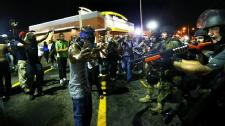
Law enforcement in the St. Louis suburb have used intense crowd control tactics over several nights of violence, including massive armored trucks to secure the streets, military-style rifles pointed at protesters and deafening sirens to disperse crowds, prompting outrage from across the political spectrum.
Protesters in Ferguson have also faced a volley of firepower from "less lethal" weapons such as tear gas, pepper balls and rubber bullets, that while nonfatal can still inflict serious physical harm.
While the vast majority of demonstrators in Ferguson have been peaceful, some acts have been violent enough to be deemed rioting, which is to say, acts of damage to persons or property committed in an assembly of six or more people (that number is as few as three in some states).
Among some of the more notable flare-ups, MSNBC reporter Chris Hayes had rocks thrown at him Monday night. St. Louis Post-Dispatch photographer David Carson reported three different instances of Molotov cocktails being lit last Wednesday night.There have been reports of looting on at least three different nights. Two men were shot on Sunday night and police officers, who say they did not discharge their weapons that night, came under "heavy fire," according to Missouri State Highway Patrol Capt. Ron Johnson. Police arrested 78 people on Monday night, according to NBC News, all but three for refusing to disperse.
Under riot conditions, the right to assembly vanishes. The First Amendment guarantees only the right to "peaceably to assemble."
Click the link below for the rest of the article!
 Visit Website
Posted by Ken at 1:43 AM
Visit Website
Posted by Ken at 1:43 AM -
Link to this entry |
Share this entry |
Print