| 
Ever feel like you need to schedule a whole day to deal with
a simple problem? Who, or what, is the problem?
Modern voicemail 'customer service' call centers are supposed
to make life easier but have become endless push
button options, hold times and representatives that don't
listen, don't understand and make you repeat your
problem over and over. Paul English was a victim who decided
to do something about it and his 'cheat sheet'
detailing how to get through to a LIVE person right away has
caught fire...
The
IVR Cheat Sheet / Get Human.com
Visit the IVR Cheat Sheet and learn how to
access over 200 companies in these Categories: finance government
insurance pharmacy products retail shipping technology telco
travel tv/satellite, rate companies you've dealt with and
find companies that have received kudo's for great customer
support.
Get involved and report your experiences to Paul's Blog -
it's easy - will make your life easier - and it's FREE!
PAUL'S STORY
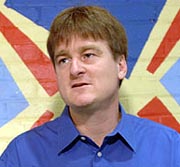
Paul English created his list because he got tired of dealing
with automated systems and wanted to get a human voice.
Sick of automation? Dial 0 for human
By Bruce Mohl, Boston Globe
The frustration is all too familiar: Call a company's customer
service line, and chances are you'll have a hard time reaching
a human.
Paul English of Arlington got tired of dealing with computerized
voice systems and decided there was only way around it: He
would put together a cheat sheet. It started small, with the
10 companies that frustrated him the most.
But the list started growing after the 42-year-old software
engineer posted it on his website earlier this year and invited
readers to make their own contributions. He now has tips for
quickly reaching an actual person at 108 companies.
Want a Visa representative? Press 0 several times, ignoring
the automated voice telling you that it's an invalid entry.
How about a Delta Air Lines human? Say ''agent" twice.
At Sprint/Nextel, press 0 five times.
''I hope companies eventually respond with 'Oh my God, I
didn't realize how painful we made it for people,' "
English said. ''I hope it's a wake-up call."
Don't count on it. The widespread proliferation of automated
customer service systems is part of a profound change in the
way American businesses deal with customers. A lot of attention
has been focused on how consumers end up speaking to call
centers in India or other countries when they phone for help.
But Gartner Inc., a market research firm in San Francisco,
said many companies are bypassing call centers altogether
by asking their customers to serve themselves with the help
of technology.
Self-service activities range from customers scanning and
bagging their own groceries to consumers using automated voice
systems or websites to purchase tickets, submit insurance
claims, manage bank accounts, or adjust financial portfolios.
By 2010, Gartner says, self-service will account for 58 percent
of all service interactions, up from 35 percent today.
The reason is cost. Richard Shapiro, president of the Center
for Client Retention in Springfield, N.J., estimates an automated
customer service system can handle a query at a cost of 8
to 15 cents a minute. The same query handled by a customer
service representative in India or the Philippines would cost
20 to 40 cents a minute, and 65 cents to $1 a minute if handled
by a US agent.
Cost is not the only advantage that automated systems enjoy.
They often improve customer service by delivering information
quickly and around the clock. They can also reduce wait times
for human customer service agents and let those agents focus
on more difficult problems.
Yet many consumers, particularly older ones, don't like talking
to computers. Shapiro estimates that 40 percent of the people
who call a company's toll-free number immediately dial 0 looking
for a live person.
Many companies have responded by taking away the option to
dial 0 and making it harder to reach a human.
Last year, some airlines started charging customers $5 per
ticket for making reservations by phone.
Sovereign Bank, one of the companies on English's cheat sheet,
said it doesn't make sense for the bank to offer the option
of dialing 0. Bank officials say it's more efficient to have
customers input their own personal data rather than have an
agent take it down.
''That costs too much money," said Jim White, senior
vice president at the bank. ''In our business, seconds count."
White said 85 percent of the 25 million people who call Sovereign
each year never talk to a human. He said that percentage should
rise slightly next year as the company adopts a more flexible
speech-recognition system.
Southwest Airlines has a different philosophy. It doesn't
want any barrier between its employees and customers, so it
routes all calls directly to customer service agents.
Erik Brynjolfsson, director of the Center for e-Business
at MIT's Sloan School of Management, said automated systems
offer a lot of benefits, but companies should keep the focus
on their customers, not on cost savings.
Mac Cummings, chief executive officer of Terakeet Corp.,
a firm in Syracuse, N.Y., that develops customer response
systems, said companies get into trouble when they ask the
systems to do too much or don't spend enough money installing
them.
Cummings said consumers get annoyed when they get put on
hold and are not told how long the wait will be, or when they
input their account number and then have to provide it again
when a customer service representative comes on the line.
Peter Mahoney, vice president for worldwide marketing at
Nuance Communications Inc. of Burlington, a company that designs
sophisticated speech recognition systems for companies such
as Amtrak and United Airlines, said consumers like the systems
and predicted acceptance would grow.
''It's similar to ATMs. People bypassed them at the start,"
Mahoney said. ''As people get comfortable with the technology
and the technology gets comfortable with people, it'll be
used more and more."
English's cheat sheet is unlikely to undermine the push toward
automation, even though references to his list are spreading
on the Web and it's closing in on 1 million hits. (Other items
on paulenglish.com are more popular, including his favorite
chocolate cake recipe.)
The cheat sheet is maintained by English and a handful of
Internet volunteers, but the group often has a hard time keeping
up with changes companies make.
English is no technophobe insisting on human-to-human interactions.
He is the chief technology officer and cofounder of Kayak.com,
a travel search engine that debuted this year. He said he
is a strong believer in using technology to make life easier
and likes automated consumer response systems, as long as
they work.
But English said companies should adopt a universal standard
for reaching a human, preferably by dialing 0. And, he said,
companies should be wary of putting too much distance between
them and their customers. Kayak, for example, requires all
software engineers, including English, to respond directly
to customer e-mails.
''It's shocking how much consumers slap us back into reality,"
he said. ''Big companies often can't do that. They're all
about cost control." |